- Xecs
- Quantum Thematic Call
Xecs annual Calls
Xecs runs calls on an annual basis. Each call is fully bottom-up, guided by the ECS Strategic Research and Innovation Agenda and supported by countries across the Eureka network. The call cycle allows extensive opportunity to generate project ideas and build collaborative consortia, with events organised to support the process. Each call operates in two stages: a Project Outline to assess support for your proposal, and a Full Project Proposal to demonstrate how you will achieve your stated goals.
Extensive expert, public authority and office support is provided throughout the call cycle – and extends into the project management phase once projects are approved.
Xecs Call 6 Timeline
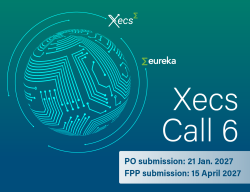 Project Outlines must be submitted by 21 January 2027, 17:00 CET in the Project Zone.
Selected project partners will be invited to prepare and submit a Full Project Proposal with a deadline of 15 April, 17:00 CEST in the Project Zone.
Xecs Call 6 RD&I areas
For the Xecs Call 6, projects can be submitted in all areas of the 2026 ECS-SRIA. However, as some countries have specific priorities in terms of funding criteria, you are strongly urged to review your Project Idea with the Public Authorities Representatives concerned at an early stage to ensure that there is close alignment between your project goal and national priorities.
National funding rules
Check also that your project meets the national funding rules by contacting your Public Authority representatives.
Xecs Call 6 eligibility criteria
Your project must meet these eligibility criteria here.
Xecs Call 6 four steps
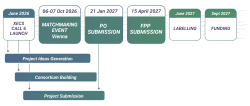
Your participation in Xecs will flow through 4 steps:
- Step 1 - Project Idea Development
- Step 2 - Consortium Building
- Step 3 - Project Submission and Evaluation
- Step 4 - Project Management
Project Idea Development
This should be a continuous process, but will be catalysed by the Xecs call timetable. You will be alerted to the upcoming call timetable in early Summer, and this should begin the development of potential ideas for projects. A useful service for looking at ideas or finding partners for your ideas is the AENEAS Events Platform. It is open to all and available 24/7 online.
Consortium Building
You can meet potential collaborators through the AENEAS Events Platform or attend the events we organise to specifically promote networking and idea-sharing. In addition, to inform you of funding options, some countries will organise webinars that will inform you of the Xecs Call and the conditions under which funding support may be provided. Stay tuned for the upcoming events.
Project Submission & Evaluation
Xecs Projects are submitted through the Xecs Project Zone in two stages – a Project Outline and a Full Project Proposal, written in English. Here you will find all the tools and information that will allow you to submit your project online. Of course, the Xecs office is available throughout this process to support you and answer any questions you may have. Extensive online guidance and help are also available.
Project Outlines are evaluated by technical experts and Public Authorities and successful projects are invited to submit a Full Project Proposal. All projects receive extensive feedback to help create the best possible FPP, or for those not invited, inform a possible future project submission. The Full Project Proposals then go through a second evaluation cycle and funding decisions made, generally subject to the completion of individual country National/Partner funding processes.
Project Management
Once funding is confirmed, the project will be initiated at a “Kick-Off” meeting. Based on funding decisions and developing ideas, most projects then go through a first “Change Request” process to set the baseline for all the work that will follow. This may be repeated as required to consider the subsequent project and partner modifications. The office will work with you on a reporting and review process over the 3 years of the project and we will help create a Project Outline and Project Impact Summary at the beginning and end of the project for external publication. As in all the other phases, the emphasis will be on giving you the maximum support possible, technical and otherwise, to ensure a successful “high impact” outcome for all partners in an Xecs project. Extensive opportunities for communicating your project progress and results will also be provided, through publications, videos and social media activities.
Accelerating the Industrialisation of Quantum Technologies
The first Xecs Thematic Quantum Call supports international collaborative R&D projects that advance the industrialisation and commercialisation of quantum technologies. The call focuses on applied innovation, helping technologies progress from Technology Readiness Levels (TRL) 4–5 to TRL 6–7 and complements broader European initiatives, including those supported by the Chips Joint Undertaking. By bringing together industry, SMEs, research organisations and academia, the Xecs Quantum Call aims to strengthen Europe's quantum ecosystem and accelerate the transition of promising technologies from laboratory demonstrations to market-ready solutions.
Xecs Quantum Call Process
Your participation in the Xecs Quantum Call will follow four key steps, similar to the annual bottom-up calls:
1. Project Idea Development
The development of project ideas should begin as early as possible, respecting the Xecs Quantum Call timeline. Organisations are encouraged to identify innovation opportunities in quantum technologies and explore potential collaborations ahead of the submission deadlines.
The Xecs Quantum Call focuses on applied quantum technologies, supporting projects that accelerate the industrialisation and commercialisation of innovative solutions in areas such as:
- quantum sensing
- quantum metrology
- quantum communications and cybersecurity
- enabling Electronic Components and Systems (ECS) technologies for quantum computing.
A useful service for exploring project ideas and identifying potential partners is the AENEAS Events Platform.
2. Consortium Building
Building a strong international consortium is a key success factor for any Xecs project. Participants can identify and connect with potential partners through the AENEAS Events Platform and by attending the Xecs Matchmaking Event, organised alongside the Xecs Call 6 Matchmaking Event in Vienna on 6-7 October 2026.
The Matchmaking Event offers opportunities to:
- Present or discover others' project ideas;
- Meet potential consortium partners;
- Explore complementary expertise and capabilities;
- Discuss funding opportunities with the Xecs community, including your national contact points
Participants are also encouraged to engage early with their national funding agencies to understand eligibility requirements and funding conditions.
As of July 2026, Xecs Quantum Call is supported by Austria, Canada, Finland, Ireland, Latvia, Spain, Türkiye, Ukraine.
Funding is subject to national rules, budgets and eligibility criteria in each participating country. Additional countries may join the call during its lifetime.
3. Project Submission & Evaluation
Projects are submitted through the Xecs Project Zone in two stages:
- Project Outline (PO)
- Full Project Proposal (FPP)
All submissions must be prepared in English.
Project Outlines are evaluated by technical experts and Public Authorities. Successful projects are invited to submit a Full Project Proposal. Detailed feedback is provided to help applicants strengthen their proposals and maximise their chances of success.
Full Project Proposals then undergo a second evaluation process, after which funding decisions are made, subject to the completion of applicable national funding procedures.
The Xecs Office remains available throughout the process to provide guidance and answer applicants’ questions.
4. Project Management
Once approved and funded, projects enter the implementation phase. Xecs supports project monitoring throughout the project lifecycle and provides visibility through its communication channels and events. Participants become part of the wider European Electronic Components and Systems and quantum innovation ecosystem, creating opportunities for collaboration, dissemination and future exploitation of project results. Project consortia are expected to actively manage technical progress, reporting activities and dissemination actions in line with national funding requirements and Xecs project monitoring procedures.
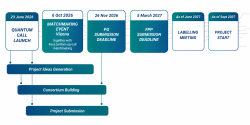
Xecs Quantum Call Timeline
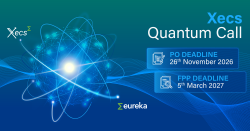 Project Outlines must be submitted by 26 November 2026, 17:00 CET in the Project Zone.
Selected project partners will be invited to prepare and submit a Full Project Proposal with a deadline of 5 March 2027 in the Project Zone.
Call Scope
The Xecs Quantum Call supports projects addressing one or more of the following technology domains.
1. Quantum Sensing
Quantum sensors have the potential to provide unprecedented levels of precision, sensitivity and accuracy across a wide range of applications.
Projects may target:
- Healthcare and medical diagnostics
- Imaging technologies
- High-precision navigation
- Industrial monitoring
- Environmental measurement
- Geological surveying
- Space and deep-space applications
Proposals should demonstrate progress towards miniaturisation, integration and industrial scalability.
2. Quantum Metrology
Quantum metrology is a key enabler for the successful industrial adoption of quantum technologies.
Projects may address:
- Validation and certification methodologies
- Benchmarking frameworks
- Standardisation activities
- Testing environments for quantum technologies
- Performance evaluation of quantum devices and systems
The objective is to establish the measurement and validation foundations required for a sustainable and globally scalable quantum economy.
3. Quantum Communications and Cybersecurity
Projects should contribute to the advancement of secure quantum communications through improvements in:
- Performance. Increasing bit rates, fidelities, transmission distances, deployment capabilities and robustness.
- Integration. Combining quantum communications with conventional network infrastructures, security services, photonic and electronic platforms, and future quantum computing systems.
- Industrialisation. Developing sustainable, cost-effective and scalable technologies capable of delivering clear economic and societal benefits.
4. Enabling ECS Technologies for Quantum Computing
Future quantum computing systems will require highly specialised electronic and photonic technologies capable of controlling, reading out and scaling millions of qubits.
This topic focuses on enabling ECS technologies, including:
- Cryogenic electronics
- Low-noise control and readout circuitry
- Signal amplification technologies
- Integrated photonics
- Single-photon detectors
- Advanced packaging and integration solutions
While the implementation of quantum processors or qubits themselves is outside the scope of the call, enabling technologies supporting their operation and scalability are fully within scope.
Why Participate?
The Xecs Quantum Call offers participants the opportunity to:
- Develop innovative quantum technologies with strong market potential;
- Build international partnerships across industry, SMEs, research organisations and academia;
- Accelerate the transition from research to industrial deployment;
- Access national funding through the Eureka Cluster Xecs framework;
- Contribute to Europe's strategic ambitions in quantum technologies;
- Position organisations within the rapidly growing quantum ecosystem.
Eligibility
To apply, projects must meet the following eligibility criteria:
- Represent international cooperation in the form of a collaborative R&D project;
- Be directed towards the development of an innovative product, process or service with commercialisation potential;
- Have a civilian purpose;
- Include at least two independent legal entities from a minimum of two Eureka countries;
- Ensure that no single organisation or country represents more than 70% of the total project budget.
The Xecs Quantum Call is implemented within the Eureka Cluster framework. Funding is provided by participating national and regional funding authorities according to their respective rules and available budgets. Funding conditions may vary between countries.
Applicants are strongly encouraged to contact their national funding agencies at an early stage to verify eligibility requirements, funding rates and submission procedures.